
The complete study skills guide for Class 10 students (2026)
Class 10 board exams test more than subject knowledge - they test how you study. This guide covers the proven techniques top students use, from Pomodoro to spaced repetition.
CLASS X
5/24/20267 min read


Class 10 is a year most students underestimate until they're in it. The syllabus expands, board exams appear on the horizon, and the standard advice—study more, study harder—stops being enough. Students who consistently score well in CBSE, ICSE, and SSC boards share one thing: they've figured out how to study, not just how many hours.
This guide covers the specific techniques that work. Not general motivation, but concrete methods with clear implementation steps—the kind that show up repeatedly in education research and student communities when people ask what actually made a difference.
Building a study schedule that doesn't fall apart
Before any technique, you need a structure. Six to eight focused hours per day is the research-backed sweet spot for Class 10 students—pushing to ten or more hours causes diminishing returns and burnout when sustained across months.
A workable weekly plan starts with listing every subject and estimating how much time each needs. Distribute subjects across the week rather than batching them. Most students skip this: block 30% of your total study time for revision. Not learning new material—revisiting what you've already covered. That 30% is what converts studying into actual exam performance.
Daily structure that works:
Start each session with 10 minutes of reviewing yesterday's material
Alternate subjects throughout the day to prevent mental fatigue on one topic
Write down what you'll cover before you open your books, not while you're already in the middle of a chapter
A physical planner or digital calendar helps. The act of crossing items off builds momentum and makes it easier to see where time is actually going.
The Pomodoro technique: study in sprints
The Pomodoro Technique is the most consistently recommended time management method across student communities, and with good reason—it prevents the mental fatigue that makes a three-hour session feel twice as long.
How it works:
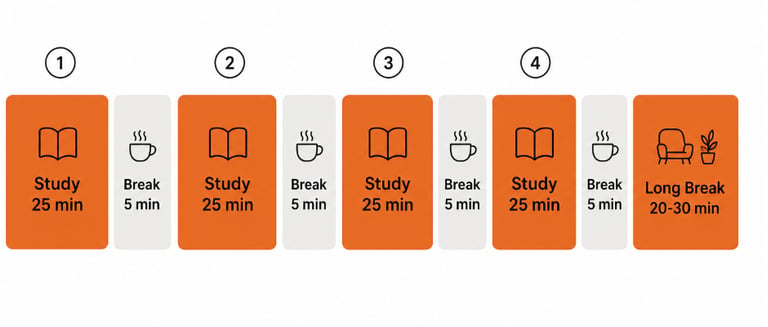
Set a timer for 25-45 minutes of focused study
When it ends, take a strict 5-15 minute break (move, stretch, water - not social media)
Complete 4 cycles
After 4 cycles, take a longer break of 15-30 minutes
The break is not optional and is not laziness. Your brain consolidates information during rest, so studying through breaks actually reduces the return on the time you've already put in.
Apps that work well: Forest, Focus Keeper, or a basic phone timer. The timer is the point; it removes the decision of when to stop.
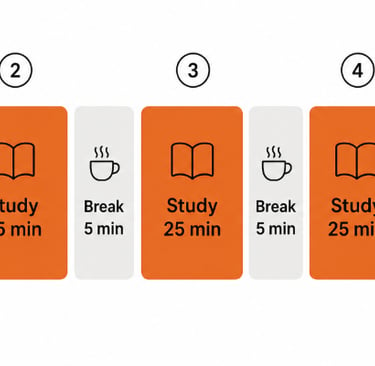
The Pomodoro study cycle: 4 focused work blocks separated by short breaks, followed by a longer rest
Spaced repetition: why cramming fails you
The research on cramming is unambiguous. Information reviewed in one long session just before an exam doesn't transfer to long-term memory—it survives the test and then largely disappears. Students who cram find these subjects impossibly hard in later terms because earlier material hasn't actually stuck.
Spaced repetition works differently. You review material at increasing intervals, revisiting it just as it would otherwise start to fade. Each retrieval attempt strengthens the memory trace.
The 1-3-5-7 rule is the simplest implementation:
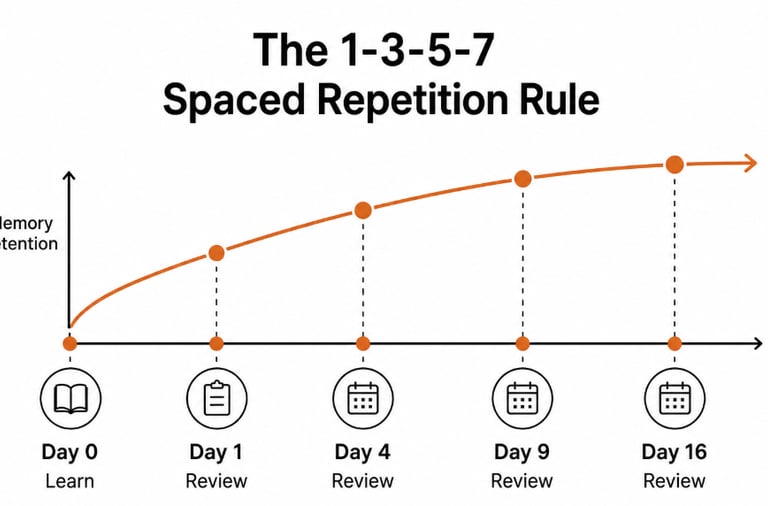
Review material 1 day after first learning it
Review 3 days after that again
Review 5 days after that again
A final review 7 days after that
This means planning backward from your exam date, not forward from when you first cover a chapter. A revision calendar built in the first week of term saves enormous stress in the final month.
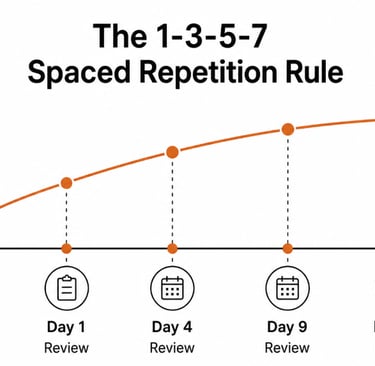
The 1-3-5-7 spaced repetition rule: review at increasing intervals to move information into long-term memory
Active recall: the technique most students skip
Re-reading your notes feels like studying. It produces a sense of familiarity that the brain misreads as learning. But passive review keeps information in short-term memory - it's available right after reading and gone by the next day.
Active recall is the opposite: testing yourself on material rather than reviewing it. The effort of retrieving information is precisely what strengthens the memory pathways that make it accessible under exam conditions.
The blurting method is the simplest version: after a study session, take a blank sheet and write down everything you can remember about the topic without checking your notes. Compare what you wrote to your actual notes. The gaps are where you study next.
Other forms of active recall:
Answer textbook questions before reading the chapter (not after)
Quiz yourself using flashcards or past paper questions
Explain a concept out loud to yourself, a friend, or a family member
Close your notes and reconstruct the key points of a chapter from memory
Students who make this switch typically see improvements in retention within a few weeks because they're practicing retrieval in every session, not just during exams.
The Feynman technique: understanding vs. memorizing
Nobel Prize-winning physicist Richard Feynman had a test for whether he truly understood something: could he explain it in plain language, without jargon, to someone who knew nothing about the subject?
The Feynman technique applied to Class 10 study:
Pick a concept you're working on
Write an explanation of it as if you're teaching a child - simple words, no jargon, just the core idea
Where your explanation gets vague, circular, or requires words you can't define - that's exactly where your understanding has a gap
Go back to the source material for those specific gaps
Rewrite until the explanation is genuinely simple
This is particularly valuable for Science and Mathematics, where formula memorization can mask a surface-level understanding that falls apart on unfamiliar question types. A student who can explain why Newton's second law works will almost always outperform one who can only recite F = ma.
Subject-specific strategies
Study techniques work differently across subjects. Here's what research and student communities consistently recommend for each Class 10 core subject:
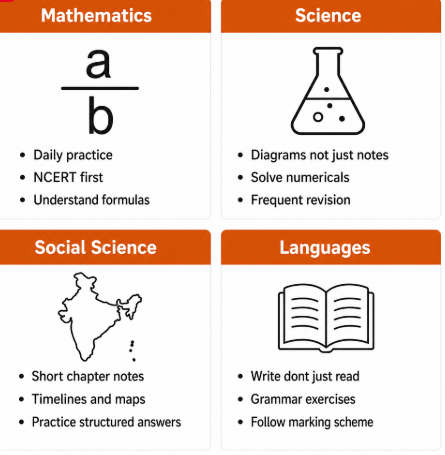
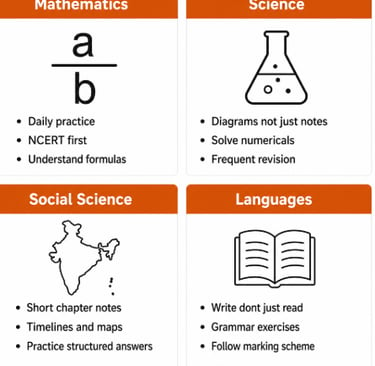
Subject-specific study strategies for Class 10: Mathematics, Science, Social Science, and Languages
Mathematics - Daily NCERT practice is non-negotiable. Focus on understanding why a formula works, not just how to apply it. Speed and accuracy are both built through repetition, not shortcuts. Solve each chapter's exercise fully before moving on.
Science (Physics, Chemistry, Biology) - Use diagrams and flowcharts for processes—draw them from memory, not just annotate printed ones. Solve numerical problems daily. Learn experiment procedures clearly, as these appear directly in board papers.
Social Science - Create short chapter notes in your own words. Use maps and timelines. Practice structured long and short answers, because marks in this subject depend heavily on answer presentation and completeness.
Languages - Daily reading builds vocabulary and grammar intuition faster than exercises alone. Write practice essays, letters, and compositions - don't just read model answers. Study the marking scheme for each question type.
Across all subjects, prioritize NCERT first and additional reference books second. The majority of Class 10 board questions are drawn directly from the NCERT material.
Cornell note-taking: notes you can actually use for revision
Most students take notes and then never use them productively. Cornell note-taking builds self-testing into the format from the start.
Page setup:
Draw a vertical line roughly 2 inches from the left edge of the page
Leave a 1-inch strip at the bottom of the page
During class or reading, write main notes in the wider right section. Focus on key ideas and concepts, not every sentence.
After class: go back and write questions or cue words in the narrow left column - prompts that would trigger recall of what's in the right column. "What is the difference between arteries and veins?" rather than "veins and arteries."
Before exams: cover the right side and use the left column prompts to test yourself. What you can't recall from prompts alone is what needs more work.
The bottom strip becomes a 2-3 sentence summary of the full page, written in your own words. For board exam revision, this summary section becomes a rapid-review tool for the night before an exam.
Exam preparation: the final 30 days
With a month to go, the priority shifts entirely:
Stop learning new topics. If something hasn't been revised yet, add it to a revision schedule and prioritize it—but don't start fresh chapters.
Solve at least 3-4 previous-year papers per subject under timed conditions. Treat these like the real exam: no notes, no stopping, and timed strictly.
After each mock paper, categorize your errors: conceptual gaps (need more study), calculation or silly mistakes (need careful checking habits), or time management issues (need pacing practice). Each category has a different fix.
Work on answer-writing speed for language and social science exams. Many students know the content but lose marks because their answers are incomplete in the time available.
On exam day:
Review only short notes and summaries. Don't open full textbooks.
Read each question twice before writing.
Allocate time by section before you start answering.
Write neat, structured answers—presentation affects board exam scoring more than most students expect.
The key insight for the final 30 days: if you've followed a spaced repetition schedule through the term, this period is entirely revision, not discovery. That's the goal—arriving at board month having already covered everything once.
Sleep, movement, and what to eat
There's a belief among Class 10 students that sleeping less means studying more. Cognitive science says the opposite: the brain consolidates the day's learning during sleep. Cutting sleep to study more erodes the return on every study hour already put in.
What actually helps:
7-8 hours of sleep is not optional during board prep - it's part of the study plan
20-30 minutes of physical activity daily improves focus and retention; a walk between study sessions is genuinely productive
Hydration affects concentration more visibly than most students realize; keep water at the study desk
5 minutes of deep breathing before a study session reduces anxiety and improves attention - SAS Institute includes yoga as part of their student program for this reason
Heavy meals just before studying reduce focus. Moderate meals and regular hydration throughout the day work better than skipping meals and eating large in the evening.
Try SAS Institute
SAS Institute in Malakpet, Hyderabad, offers coaching for CBSE, ICSE, SSC, IIT JEE, and NEET with small batch sizes and concept-based teaching—the kind that builds the deep understanding the Feynman Technique is designed to test for. Students and parents consistently cite personalized attention and measurable improvement in confidence and exam performance.
SAS Institute website - coaching center in Hyderabad for CBSE, ICSE, SSC, IIT JEE, and NEET
If you want structured guidance on applying these study skills to your specific syllabus and exam, reach out to SAS Institute directly via their website or on WhatsApp at +91 77990 98666.